Shandong Fengtu IOT Technology Co., Ltd
Sales Manager:Ms. Emily Wang
Cel,Whatsapp,Wechat:+86 15898932201
Email:info@fengtutec.com
Add:No. 155 Optoelectronic Industry Accelerator, Gaoxin District, Weifang, Shandong, China


Sales Manager:Ms. Emily Wang
Cel,Whatsapp,Wechat:+86 15898932201
Email:info@fengtutec.com
Add:No. 155 Optoelectronic Industry Accelerator, Gaoxin District, Weifang, Shandong, China
time:2025-05-20 09:18:55 source:Weather Station viewed:851 time
In the photovoltaic industry, measuring the power of photovoltaic (PV) modules is crucial for accurately assessing their power generation capacity and performance. This enables manufacturers to ensure product quality compliance, while maintenance personnel can promptly detect changes in module performance, ensuring efficient and stable operation of power plants and enhancing power generation revenue.
How is PV module power tested? A Portable IV Curve Tester can be used, operating on the principles of the photoelectric effect and circuit measurement. A typical testing process involves:
Correctly connecting the PV module to the tester.
Setting the light intensity and spectral distribution of the simulator to replicate real-world lighting conditions.
Placing the PV module in an open-circuit state to measure the open-circuit voltage.
Conducting a voltage sweep, gradually increasing the operating voltage from 0V while simultaneously measuring the corresponding output current. These voltage and current data points are plotted to form an IV curve.
The IV curve visually illustrates the current response of the PV module at different voltages, revealing key performance parameters such as photoelectric conversion efficiency, fill factor, and maximum power point. By comparing the actual IV curve with theoretical curves or historical data, potential faults in the module—such as cracked cells or damaged connections—can be quickly identified.
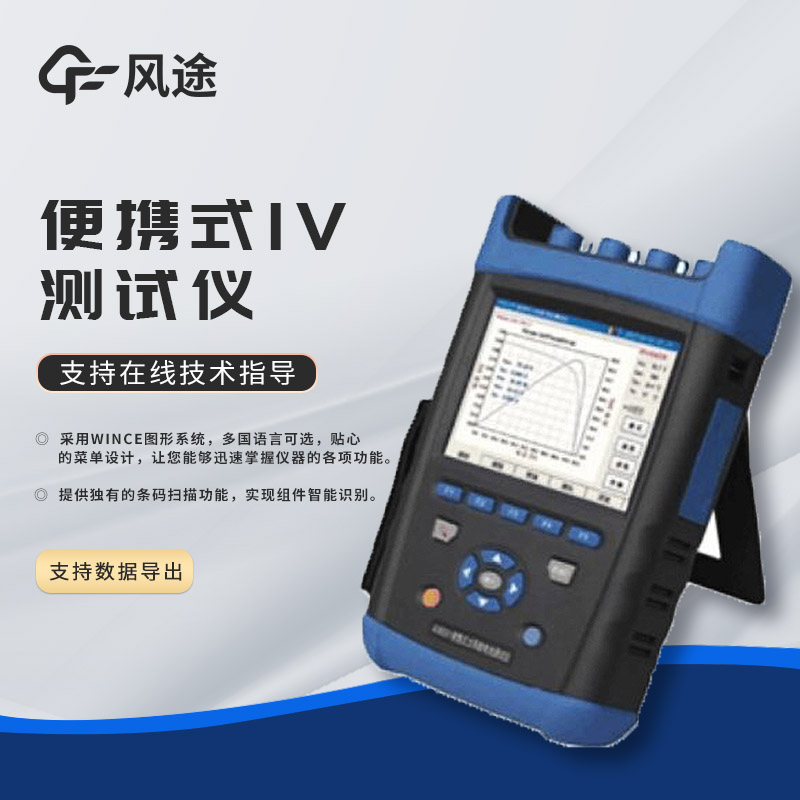
The FT-IV2 Portable IV Curve Tester offers a voltage measurement range of up to 1500V and current measurement up to 20A, capable of testing PV modules with a power rating of 30kW. It accurately measures parameters such as open-circuit voltage, short-circuit current, and maximum power of solar cell modules/arrays. Features include:
User-friendly operation and portability.
High-precision irradiance meter and temperature sensor for on-site irradiance and temperature data.
Integrated packaging technology with a clear functional interface, enabling one-click data export.
Fast detection speed (10 seconds per module/string).
High-precision capacitive/resistive load, rapid irradiance meter operation module, and IV curve analysis software for detailed curve interpretation.
Continuous IV scanning capability, making it an ideal choice for third-party inspection agencies and power plant maintenance teams.
Explosion-proof automatic weather station, mainly used for environmental monitoring and management in electric power, petroleum, chemical and other industries, is a meteorological observation instrument. It can monitor the changes of various meteorological data in the atmosphere exactly within a cer...
Fengtu Automatic Soil Monitoring System is dedicated to mitigating the effects of drought disasters by deploying soil moisture sensors and integrating web-based technologies to create a comprehensive decision-aid platform that integrates soil moisture data management, querying, and predictive analyt...
liquid sensor is used to monitor the liquid level in industrial production, aquarium, chemical liquid and other containers....
The ultrasonic wind speed and direction sensor is a highly accurate, fully digital detection device with the following features:Integrated design: wind speed and wind direction detection in one unit, providing accurate wind speed and wind direction data.Signal processing: Built-in signal processing...


 Skype
Skype
 whatsapp
 mail
mail