Shandong Fengtu IOT Technology Co., Ltd
Sales Manager:Ms. Emily Wang
Cel,Whatsapp,Wechat:+86 15898932201
Email:info@fengtutec.com
Add:No. 155 Optoelectronic Industry Accelerator, Gaoxin District, Weifang, Shandong, China


Sales Manager:Ms. Emily Wang
Cel,Whatsapp,Wechat:+86 15898932201
Email:info@fengtutec.com
Add:No. 155 Optoelectronic Industry Accelerator, Gaoxin District, Weifang, Shandong, China
time:2025-02-25 09:53:06 source:Weather Station viewed:752 time
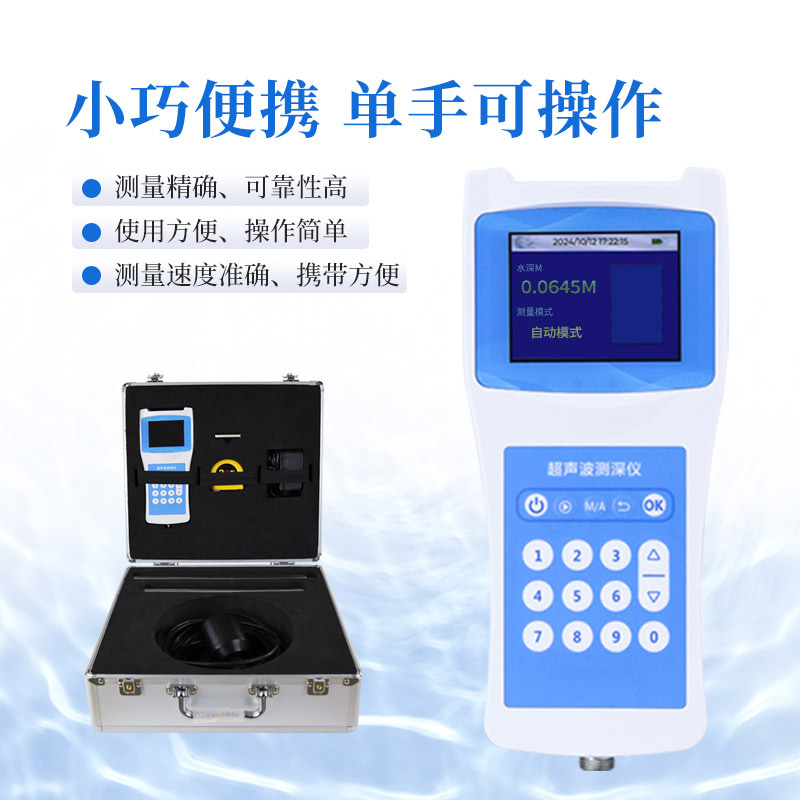
In many fields such as water conservancy, fishery, and navigation, accurately measuring water depth is a fundamental and crucial task. Whether it's the maintenance of waterways, the monitoring of reservoirs, or the control of the aquaculture environment, water depth data plays an indispensable role. Traditional methods of measuring water depth have many inconveniences. Is there a more efficient and convenient solution? Today, I will introduce you to a magical device - the Portable ultrasonic sounder FT - CS150.
In the past, the commonly used methods for measuring water depth included sounding rods and sounding weights. Although the sounding rod is simple and direct, it is limited by its length and becomes ineffective in deeper waters. Moreover, it is very labor - intensive to operate and has low efficiency. The sounding weight measures by relying on gravity to sink, and it is greatly affected by water flow and wind waves, so it is difficult to ensure the measurement accuracy. In complex water environments, these traditional tools are even more difficult to function and cannot meet the requirements of modern work for data accuracy and work efficiency.
The emergence of the Portable ultrasonic sounder FT - CS150 has overcome the shortcomings of traditional sounding methods. It uses the reflection principle of ultrasonic waves to quickly and accurately measure water depth.
The ultrasonic transducer inside the instrument emits high - frequency ultrasonic pulses underwater. These pulses propagate in water at a specific speed. When they encounter the bottom interface, they are reflected. The reflected ultrasonic pulses are received by the transducer. Since the propagation speed of ultrasonic waves in water is known, and the instrument can accurately record the time interval from the emission to the reception of the ultrasonic pulses. According to the formula: water depth = sound speed × propagation time ÷ 2, the distance from the water surface to the bottom, that is, the water depth value, can be accurately calculated. This non - contact measurement method not only avoids many disadvantages of traditional contact - type measuring tools but can also adapt to various complex underwater environments.
The FT - CS150 is small in size and light in weight, making it convenient to carry. Staff can easily take it to the work site. Unlike traditional large - scale sounding equipment, which requires the help of professional vessels and a large amount of human and material resources for transportation and operation, the FT - CS150 can be easily operated by one person, improving the flexibility of work.
The safety level of slope engineering is divided into first, second, and third levels according to factors such as damage consequences, types, and heights. The monitoring section is often selected at geologically weak or representative locations.The layout of monitoring points for slope automation m...
With the rapid development of science and technology, modern meteorological and environmental monitoring systems, as the core of the operational meteorological monitoring system, are of great significance in enhancing the level of public meteorological services and improving the accuracy of meteorol...
Ultrasonic wind speed and direction sensors work by measuring the difference in propagation time of ultrasonic waves in different directions to determine wind speed and direction. Specifically:Ultrasonic waves have different propagation times in the downwind and upwind directions. When the wind is b...
Transmission lines are often exposed to a variety of natural challenges outdoors, such as storms, floods and earthquakes. To ensure the stability and security of the grid, designs need to take into account the need to enhance the robustness of the towers, use materials that can withstand severe weat...


 Skype
Skype
 whatsapp
 mail
mail