Shandong Fengtu IOT Technology Co., Ltd
Sales Manager:Ms. Emily Wang
Cel,Whatsapp,Wechat:+86 15898932201
Email:info@fengtutec.com
Add:No. 155 Optoelectronic Industry Accelerator, Gaoxin District, Weifang, Shandong, China


Sales Manager:Ms. Emily Wang
Cel,Whatsapp,Wechat:+86 15898932201
Email:info@fengtutec.com
Add:No. 155 Optoelectronic Industry Accelerator, Gaoxin District, Weifang, Shandong, China
time:2025-02-26 09:57:36 source:Weather Station viewed:752 time
Three Advantages of Air Quality Monitoring Station
1. High Flexibility
The Air Quality Monitoring Station is small in size and light in weight, allowing it to be flexibly deployed at various locations according to actual needs. It can be set up in different urban neighborhoods, industrial parks, schools, hospitals, and even in some remote areas or specific sites that are difficult for traditional monitoring stations to reach, achieving fine - grained monitoring of air quality.
It can be quickly moved and redeployed in response to changes in monitoring tasks or the dynamic development of pollution situations. This enables real - time tracking and monitoring of air quality in different regions, providing timely and accurate data support for environmental management and decision - making.
2. Low Cost
The hardware equipment of the Air Quality Monitoring Station is relatively simple. It doesn't require the construction of specialized monitoring buildings like traditional large - scale monitoring stations, nor does it need to be equipped with a large number of complex and expensive analytical instruments, which greatly reduces the construction cost.
Since the Air Quality Monitoring Station has low power consumption, the required maintenance workload and maintenance costs are relatively small. Moreover, its data transmission usually adopts wireless communication technology, reducing the cost of laying wired networks, and the overall operation cost is significantly reduced.
3. Fast Response
The Air Quality Monitoring Station uses electronic sensor technology to monitor and analyze air pollutants in real - time, quickly obtaining air quality data. With a monitoring frequency at the minute - level or even second - level, it can promptly reflect changes in air quality.
Through the built - in wireless communication module, the Air Quality Monitoring Station can rapidly transmit real - time monitoring data to the data center or relevant management platforms. This enables managers to understand the air quality conditions immediately, detect pollution problems in a timely manner, and take corresponding measures, providing strong support for environmental emergency response and pollution prevention and control.
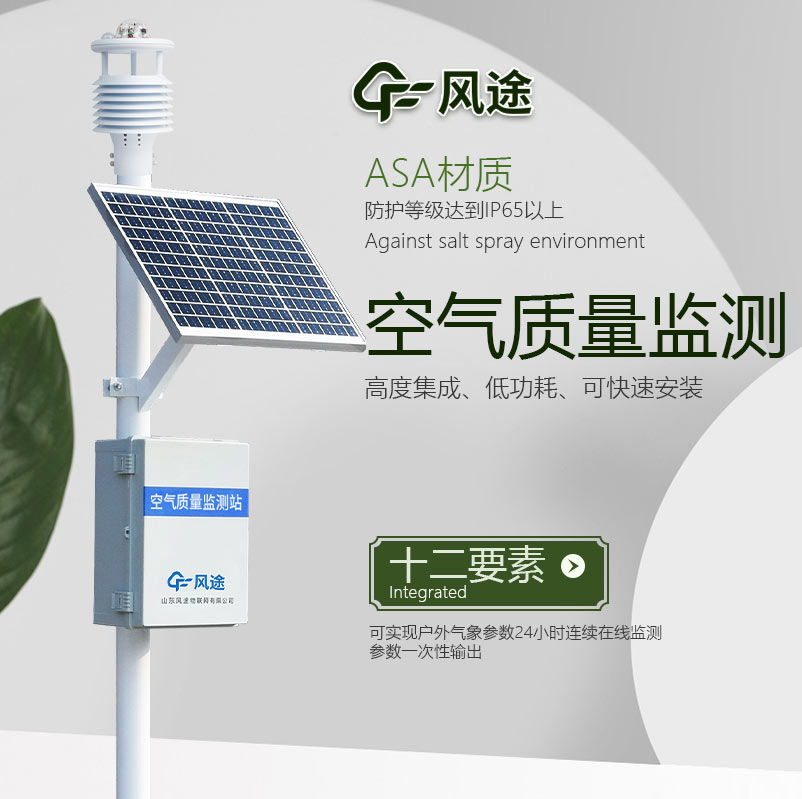
6 elements automatic weather observation station FT-CQX6 is a civil weather station product launched by Windway Technology, which is based on ultrasonic weather sensor and can monitor the conventional six elements in real time: wind speed, wind direction, air temperature, air humidity, air pressure...
Handheld Depth Finder is a handheld ultrasonic depth-sounding device capable of simultaneously monitoring both water depth and temperature; it is suitable for measurement operations in reservoirs, lakes, rivers, and shallow coastal waters. Handheld Depth Finder is a portable...
Campus weather station equipment is the main product of the source manufacturer [Windway Technology], we have launched many models of campus weather station equipment, among which the FT-XQX10 model sells best and is the most popular. So what exactly are the advantages of this equipment? Let's t...
Explosion-proof automatic weather station, mainly used for environmental monitoring and management in electric power, petroleum, chemical and other industries, is a meteorological observation instrument. It can monitor the changes of various meteorological data in the atmosphere exactly within a cer...


 Skype
Skype
 whatsapp
 mail
mail