Shandong Fengtu IOT Technology Co., Ltd
Sales Manager:Ms. Emily Wang
Cel,Whatsapp,Wechat:+86 15898932201
Email:info@fengtutec.com
Add:No. 155 Optoelectronic Industry Accelerator, Gaoxin District, Weifang, Shandong, China


Sales Manager:Ms. Emily Wang
Cel,Whatsapp,Wechat:+86 15898932201
Email:info@fengtutec.com
Add:No. 155 Optoelectronic Industry Accelerator, Gaoxin District, Weifang, Shandong, China
time:2024-10-12 08:39:07 source:Weather Station viewed:771 time
In a wheat planting area in the North China Plain, Soil Moisture Testing Equipment is playing an important role.
This area has set up multiple soil moisture monitoring points. Each monitoring point is equipped with advanced sensor equipment. These sensors can monitor soil moisture, temperature and other soil moisture data at different depths (such as 10 centimeters, 20 centimeters, 40 centimeters, etc.) in real time.
During the sowing period of wheat, Soil Moisture Testing Equipment begins to work. At first, there was relatively more precipitation in autumn. The soil moisture data showed that the surface soil moisture was suitable, providing good conditions for the emergence of wheat. But as winter comes, the temperature drops and precipitation decreases. Through soil moisture monitoring, it is found that the surface soil moisture is frozen and the moisture in the lower layer of the soil has a tendency of slow evaporation and loss.
In spring, the wheat turning green period has an increased demand for water. Soil Moisture Testing Equipment continuously sends back data, and agricultural technicians analyze these data. When it is found that the soil moisture at a depth of 20 centimeters in some areas is lower than the suitable moisture range for wheat growth, farmers are promptly notified to irrigate. Due to the guidance of accurate soil moisture data, farmers no longer carry out flood irrigation as in the past by experience. Instead, according to the differences in soil moisture in different areas, they adopt precise irrigation methods such as drip irrigation and sprinkler irrigation.
During the irrigation process, Soil Moisture Testing Equipment continues to play a role and provides real-time feedback on the soil moisture replenishment situation. Once the appropriate moisture is reached, irrigation operations can be stopped. This not only ensures the sufficient supply of water during the growth process of wheat, improves the yield and quality of wheat, but also saves water resources, reduces unnecessary waste of irrigation water, and at the same time reduces the occurrence probability of problems such as soil compaction and nutrient loss caused by excessive irrigation. Precise irrigation achieved through soil moisture monitoring has brought significant economic and ecological benefits to this wheat planting area.
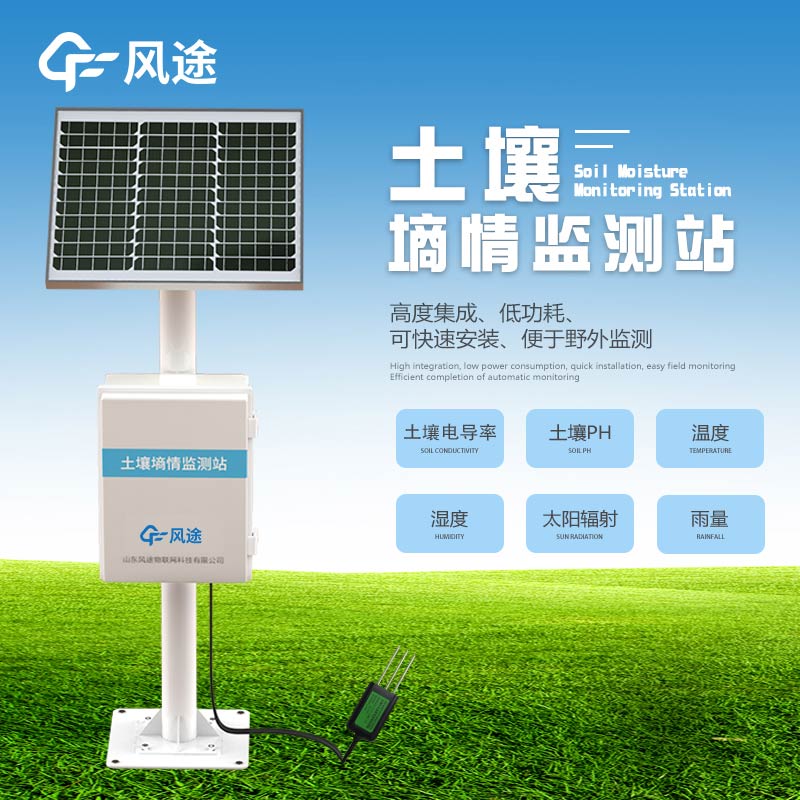
Moisture monitoring is the process of monitoring soil moisture in real time. This can be achieved by means of fixed automatic soil moisture monitoring stations (soil moisture monitors). This type of monitoring station can monitor soil moisture automatically, continuously and in real time, providing...
This is a VOC online monitoring system we launched based on PID photoionization principle. The items that can be monitored include aromatics: benzene, toluene, naphthalene, nitrobenzene, chlorobenzene, etc.; saturated and unsaturated hydrocarbons: octane, ethylene, cyclohexane, etc.; ketones, aldehy...
Ultrasonic wind speed sensor principle:It uses ultrasonic time difference method to realize wind speed and wind direction measurement. As the speed of sound propagation in the air, it will be and wind direction. Above the airflow speed iteration. If the ultrasonic propagation direction and the wind...
Radar Flow Meters is a non-contact flow measurement device utilizing a K-band planar microstrip array antenna, suitable for flow measurement in rivers, canals, natural streams, and reservoir dams. It can be used in various professional fields such as hydrological surveys, agricultural irrigation, and municipal drainage....


 Skype
Skype
 whatsapp
 mail
mail