Shandong Fengtu IOT Technology Co., Ltd
Sales Manager:Ms. Emily Wang
Cel,Whatsapp,Wechat:+86 15898932201
Email:info@fengtutec.com
Add:No. 155 Optoelectronic Industry Accelerator, Gaoxin District, Weifang, Shandong, China


Sales Manager:Ms. Emily Wang
Cel,Whatsapp,Wechat:+86 15898932201
Email:info@fengtutec.com
Add:No. 155 Optoelectronic Industry Accelerator, Gaoxin District, Weifang, Shandong, China
time:2025-05-22 09:18:40 source:Weather Station viewed:867 time
In wind farm operations, it is essential to collect wind speed and direction data. This is because wind speed directly determines the output power of wind turbines (power is proportional to the cube of wind speed). By using real-time wind speed data, combined with the turbine's power curve (the corresponding relationship between wind speed and power), the current power generation can be accurately calculated, and the short-term power generation capacity (such as 15 minutes to several hours ahead) can be predicted. Additionally, each turbine has specific "cut-in wind speed" (e.g., 3-4 m/s, the threshold to start power generation) and "cut-out wind speed" (e.g., around 25 m/s, beyond which the turbine must shut down for protection). Real-time wind speed data ensures that turbines operate within a safe wind speed range, avoiding accidents such as blade breakage or main shaft damage caused by extreme wind speeds.
Furthermore, when multiple turbines are arranged in an array within a wind farm, downstream turbines are prone to the "wake effect" of upstream turbines (reduced wind speed and increased turbulence, leading to power generation losses). Real-time wind direction data helps adjust the alignment of turbines (e.g., perpendicular to the dominant wind direction) or dynamically optimize turbine spacing through intelligent control systems to minimize wake losses.
So, how is wind speed and direction data obtained?
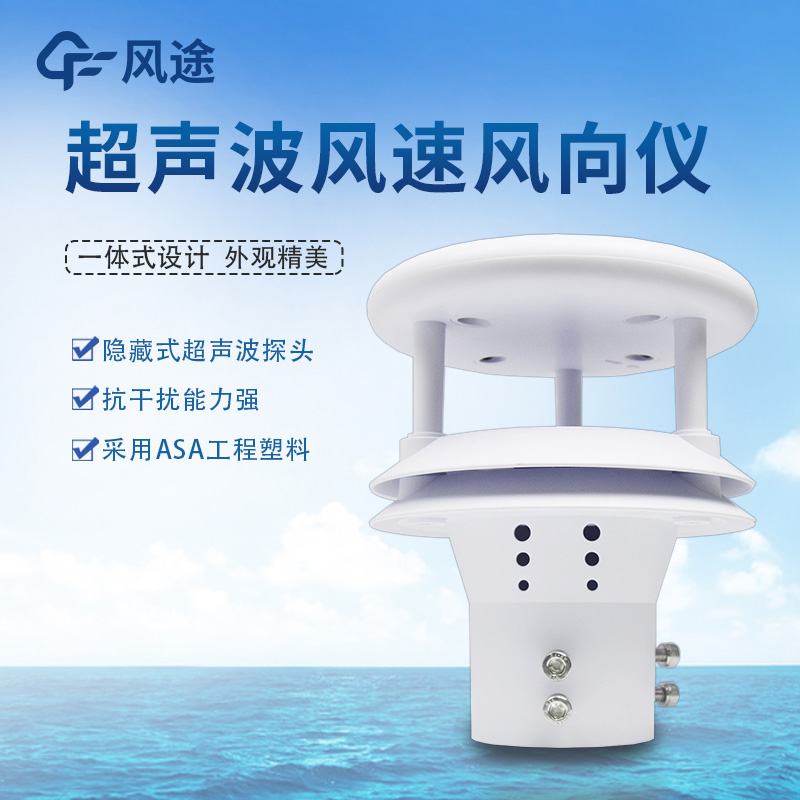
The Ultrasonic Wind Speed Direction Sensor used in wind farm turbines is a commonly employed measurement device. Based on the principle of ultrasonic time difference, four ultrasonic transducers are cross-arranged in a cross shape on the sensor's fixed base, forming two pairs of ultrasonic transmission and reception channels. When wind blows, the propagation speed of ultrasonic waves in the downwind direction is accelerated by the wind, while that in the upwind direction is decelerated. By calculating the propagation time difference of the two sets of ultrasonic waves along the same path, wind speed can be accurately converted. Wind direction is determined by the wind speed differences between channels, combined with trigonometric algorithms, to achieve precise positioning with an error within ±2°.
In the field of snow depth measurement, the Ultrasonic Snow Depth Detector and the Laser Snow Depth Monitor are two common devices. So, how should consumers make a choice?The Ultrasonic Snow Depth Detector operates in a way similar to echolocation. It emits ultrasonic waves towards the snow surface....
water level sensors A sensor that measures the level of water in a stationary container and can accurately measure the amount of liquid in the tank....
With the rapid development of science and technology, modern meteorological and environmental monitoring systems, as the core of the operational meteorological monitoring system, are of great significance in enhancing the level of public meteorological services and improving the accuracy of meteorol...
According to Article 8.1 of the AQ3036-2010 Code for Safety Monitoring and Control Installation in Tank Areas, for tank areas where there are significant sources of danger, it is necessary to install instruments for monitoring key parameters such as wind force, wind direction and ambient temperature...


 Skype
Skype
 whatsapp
 mail
mail