Shandong Fengtu IOT Technology Co., Ltd
Sales Manager:Ms. Emily Wang
Cel,Whatsapp,Wechat:+86 15898932201
Email:info@fengtutec.com
Add:No. 155 Optoelectronic Industry Accelerator, Gaoxin District, Weifang, Shandong, China


Sales Manager:Ms. Emily Wang
Cel,Whatsapp,Wechat:+86 15898932201
Email:info@fengtutec.com
Add:No. 155 Optoelectronic Industry Accelerator, Gaoxin District, Weifang, Shandong, China
time:2024-06-05 08:37:54 source:Weather Station viewed:869 time
The data collection process of smart agriculture involves detailed and continuous monitoring of farmland conditions through integrated high-tech sensing technologies, real-time monitoring systems and advanced equipment such as drones. The data collected by these technological means provide farmers with a detailed picture of farmland conditions, helping them to make more scientific decisions based on the data in order to improve the precision of agricultural production and the intelligence of management.
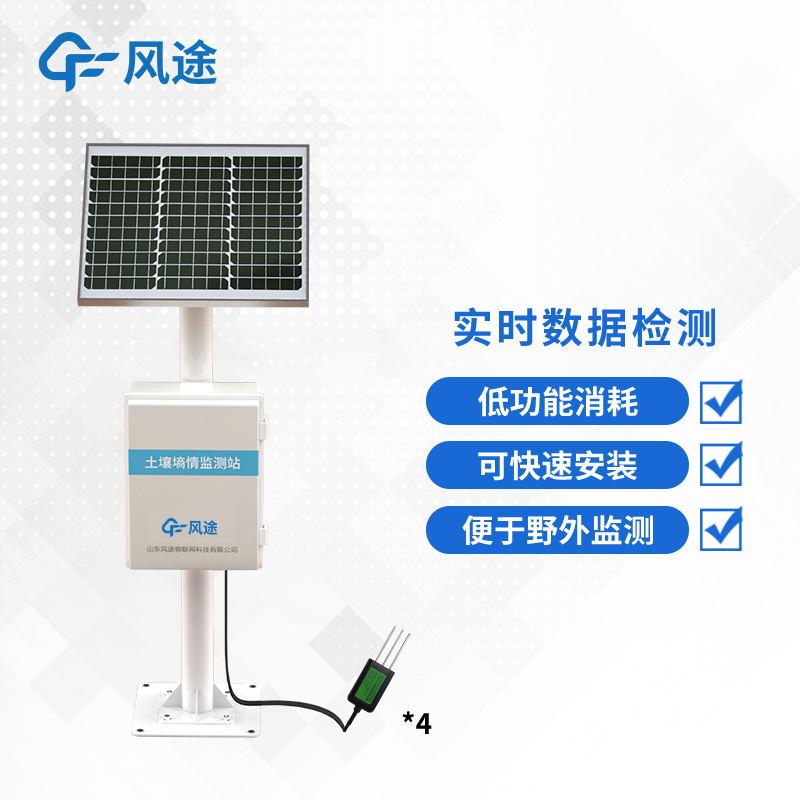
The soil environment is critical to crop growth, and agricultural activities such as irrigation and aeration can be scientifically guided by continuously monitoring soil indicators such as moisture, temperature and pH. Soil triad sensors are tools specifically designed to determine these soil properties and are known for their stability, responsiveness, fast response and accurate output for a wide range of soil conditions. By determining the soil's dielectric constant, these sensors are able to directly reflect the moisture content of the soil, providing important data support for applications such as fine agriculture, greenhouse cultivation, water-saving irrigation, plant growth research and soil moisture monitoring.
The smart agricultural soil environment monitoring system using IoT technology covers the whole process from data collection, transmission to cloud processing. The system is capable of uploading agricultural environmental data collected by sensors to the cloud platform in real time, and monitoring and intelligently controlling these data, thus providing the agricultural sector with accurate environmental monitoring, scientific management strategies, and intelligent environmental regulation. This not only enhances the intelligent level of agricultural production, but also realises precise and networked agricultural management.
A rainfall monitor is an instrument that can measure the amount of rainfall. As climate change becomes more and more serious, meteorological monitoring has become a very important task. As one of the meteorological monitoring equipment, rainfall monitor can provide important reference information fo...
Ultrasonic explosion-proof weather station is one of the main products of Windway Technology, model FT-FB02, which is manufactured for such special places as chemical plants and oil depots. It is an integrated weather station, integrating data collection, storage and communication upload, based on t...
The integrated rainfall station is an important rainfall monitoring tool. Modern integrated rainfall stations are highly automatic, so it is no longer necessary to assign special personnel to watch. It is placed in the field to automatically collect rainfall data, and then transmitted remotely throu...
In the natural water cycle system, water level and rainfall amount are two crucial parameters, which can affect human production and life as well as the stability of the ecological environment. Monitoring water level and rainfall data is essential for preventing flood disasters and rationally alloca...


 Skype
Skype
 whatsapp
 mail
mail