Shandong Fengtu IOT Technology Co., Ltd
Sales Manager:Ms. Emily Wang
Cel,Whatsapp,Wechat:+86 15898932201
Email:info@fengtutec.com
Add:No. 155 Optoelectronic Industry Accelerator, Gaoxin District, Weifang, Shandong, China


Sales Manager:Ms. Emily Wang
Cel,Whatsapp,Wechat:+86 15898932201
Email:info@fengtutec.com
Add:No. 155 Optoelectronic Industry Accelerator, Gaoxin District, Weifang, Shandong, China
time:2025-06-13 09:15:19 source:Weather Station viewed:666 time
Literally, it refers to the physical state of the road surface. For example, whether there is water accumulation, snow, ice, or moisture on the road? What are the road surface temperature and humidity? These factors constitute the road surface conditions, which are often crucial to travel safety. For instance, ice can cause vehicles and pedestrians to slip, increasing the risk of traffic accidents. Therefore, it is essential to continuously monitor and accurately measure road surface conditions.
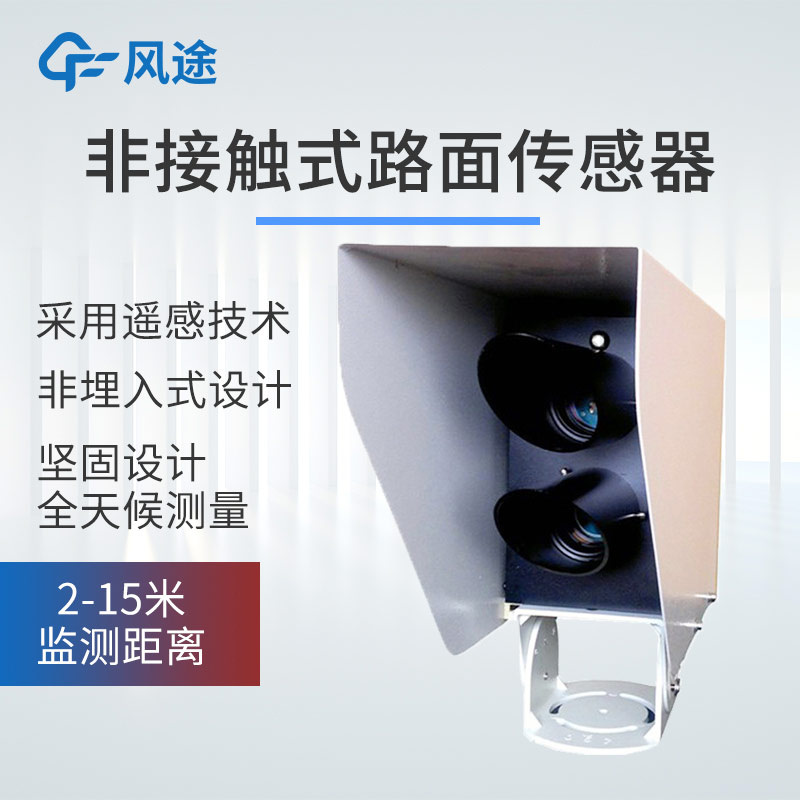
Traditional road condition measurement methods, such as manual inspection or embedded sensor measurement, suffer from problems like low efficiency, complex installation and maintenance, and damage to the road surface. To address these issues, we introduce the FT-LM2 sensor, fully known as the Non-Contact Non-Intrusive Road Condition Sensor.
Here, "non-contact" means the sensor can obtain road surface information without direct contact with the road; "non-intrusive" indicates that the sensor installation does not require damaging the road structure, avoiding impacts on normal road use; "remote sensing" utilizes optical, infrared, and other technologies to achieve long-distance detection of road conditions.
The FT-LM2 Non-Contact Road Condition Sensor can accurately measure the thickness of water accumulation, snow, and ice on the road. The measurement range for water accumulation thickness is 0.00–10 mm, with a resolution of 0.01 mm and an accuracy of 0.1 mm. The measurement range for ice and snow thickness is also 0.00–10 mm. Additionally, it can detect multiple parameters such as road surface slipperiness, temperature, and humidity, and output road status reports including dry, damp, wet, snow, ice, and ice-water mixture.
The monitoring distance of FT-LM2 is 2–15 meters, with the maximum infrared detection distance reaching 15 meters. The detection diameter is 23 cm, and the angle range is 30–90 degrees. The non-embedded design makes its installation and maintenance extremely simple, requiring no lane closure, which effectively reduces construction costs and impacts on traffic. Furthermore, the sensor has anti-corrosion capabilities, with an average fault-free time of up to 10 years and low maintenance costs. It can be installed remotely, suitable for bridge decks, accident-prone areas, high-traffic zones, and regions with frequent rain and snow. It can also be integrated into existing highway automatic weather monitoring networks, communicate via RS485 and RS232, automatically detect lens contamination, measure the pollution level, and is applicable to various road surface materials such as concrete and asphalt, contributing to road safety assurance and road maintenance.
The integrated rainfall monitoring station is a new type of equipment for real-time monitoring and analysis of precipitation in the region. The equipment adopts different types of rain sensors to automatically collect rainfall data and transmit them to the monitoring center through the network. As a...
The role of road weather monitoring system in highway construction is very important, and it is a new type of automatic weather station established on the basis of road weather service. It can not only realize real-time observation of road weather conditions and driving environment, but also provide...
Three Advantages of Air Quality Monitoring Station1. High FlexibilityThe Air Quality Monitoring Station is small in size and light in weight, allowing it to be flexibly deployed at various locations according to actual needs. It can be set up in different urban neighborhoods, industrial parks, schoo...
In the third-party pollution control of industrial parks, "monitoring" is a core link. However, scattered monitoring points face problems such as high operation and maintenance costs and difficulty in unified management. Atmospheric pollution grid monitoring technology, which combines &quo...


 Skype
Skype
 whatsapp
 mail
mail