Shandong Fengtu IOT Technology Co., Ltd
Sales Manager:Ms. Emily Wang
Cel,Whatsapp,Wechat:+86 15898932201
Email:info@fengtutec.com
Add:No. 155 Optoelectronic Industry Accelerator, Gaoxin District, Weifang, Shandong, China


Sales Manager:Ms. Emily Wang
Cel,Whatsapp,Wechat:+86 15898932201
Email:info@fengtutec.com
Add:No. 155 Optoelectronic Industry Accelerator, Gaoxin District, Weifang, Shandong, China
time:2025-05-30 09:22:46 source:Weather Station viewed:774 time
Traditional anemometers such as mechanical wind speed meters and cup anemometers rely on the rotation or swing of mechanical components like wind cups and vanes to sense wind speed and direction, presenting multiple limitations:
Mechanical Wear & High Maintenance: Long-term use leads to friction and corrosion of mechanical parts, requiring regular cleaning, lubrication, or replacement. Maintenance costs surge in harsh environments with high humidity, dust, or salt spray.
Limited Low-Speed Accuracy & Responsiveness: Mechanical structures have a startup threshold, struggling to measure low wind speeds accurately with delayed responses. They fail to capture instantaneous wind fluctuations and may deform or break under high-speed airflow, restricting measurement ranges.
Environmental Interference: Precipitation, icing, and pollutant adhesion easily disrupt mechanical operations. Installation requires strict environmental conditions, and measurement accuracy is compromised in complex terrains or confined spaces.
Single Function & Large Errors: Most traditional anemometers only measure wind speed or direction, with significant measurement errors due to mechanical precision limitations.
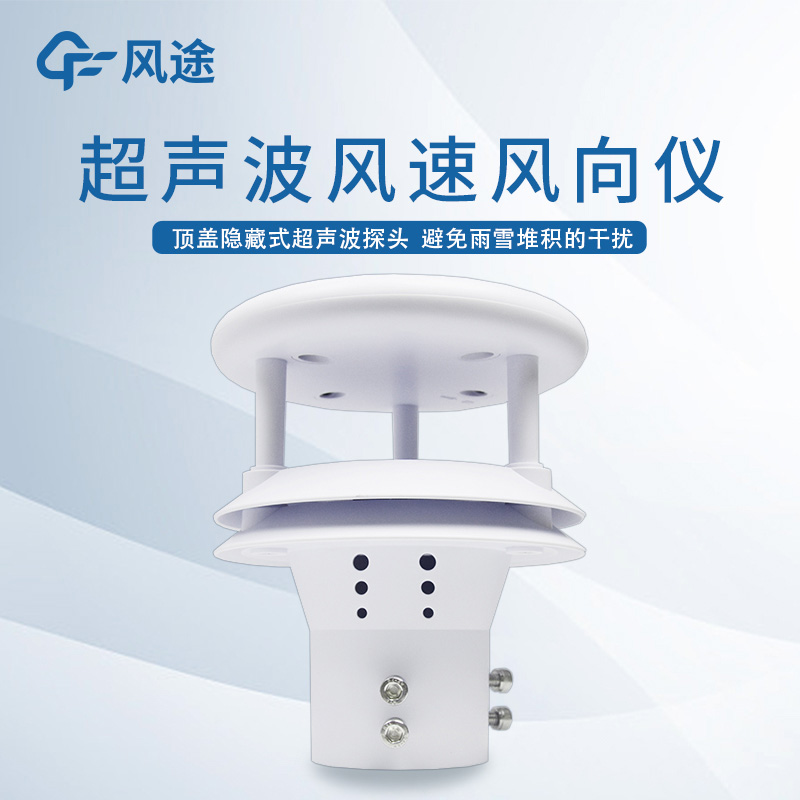
Ultrasonic Wind Speed Direction Sensor, based on the ultrasonic time-difference method, calculates wind speed by measuring the propagation time difference of sound waves in the air. Its advantages include:
No Mechanical Wear & Low Maintenance: Eliminating mechanical components fundamentally solves wear issues, requiring no regular maintenance and suiting long-term unattended scenarios.
Wide Range & High Speed: Measures from near 0 m/s breeze to 70 m/s strong winds with millisecond-level response times, accurately capturing instantaneous wind changes.
Robust Environmental Adaptability: Free from exposed mechanical parts, it resists rain, snow, icing, and dust, enabling flexible installation with minimal airflow disturbance and higher stability in harsh conditions.
Multi-Parameter & High Precision: Simultaneously measures wind speed, direction, temperature, and other parameters with smaller errors. Supports multiple communication interfaces for remote data transmission and intelligent compensation, comprehensively addressing traditional anemometers’ shortcomings in wear, adaptability, accuracy, and functionality.
Landslide monitoring equipment, as an important tool for ensuring geological safety, can monitor the characteristics of landslide masses and related environmental factors, providing crucial data for analyzing landslide risks.Displacement monitoring equipment: The GNSS monitoring system utilizes the...
The negative oxygen ion sensor in the scenic weather station is a device specialized in monitoring the concentration of negative oxygen ions. It detects the negative ions in the air by utilizing ionization and is able to measure the amount of negative ions.This sensor has the following characteristi...
Soil moisture meter is the most suitable equipment for soil moisture monitoring, which is a scientific instrument specialized in measuring soil moisture. It mainly uses sensors to collect soil moisture in real time and transmit the data to the background, and then analyzes and calculates the corresp...
Air quality sensor is a proprietary, independently developed monitor designed to measure comprehensive air environmental indices. It comes standard with an RS485 communication interface and supports the MODBUS protocol, with optional configurations available for RS232, USB, and Ethernet interf...


 Skype
Skype
 whatsapp
 mail
mail