Shandong Fengtu IOT Technology Co., Ltd
Sales Manager:Ms. Emily Wang
Cel,Whatsapp,Wechat:+86 15898932201
Email:info@fengtutec.com
Add:No. 155 Optoelectronic Industry Accelerator, Gaoxin District, Weifang, Shandong, China


Sales Manager:Ms. Emily Wang
Cel,Whatsapp,Wechat:+86 15898932201
Email:info@fengtutec.com
Add:No. 155 Optoelectronic Industry Accelerator, Gaoxin District, Weifang, Shandong, China
time:2025-07-22 09:15:45 source:Weather Station viewed:865 time
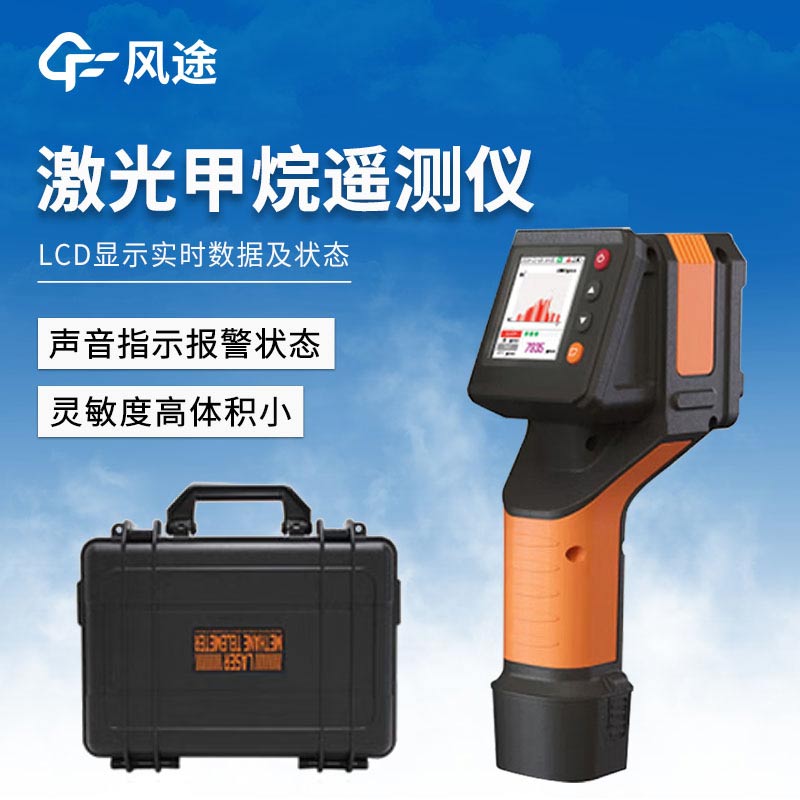
In industrial production and urban gas transmission, methane leakage is an extremely dangerous hidden hazard. Traditional detection methods often require close contact with the detection points, which is not only inefficient but also poses safety risks. However, the Laser Methane Telemeter can realize long-distance, rapid and accurate detection of methane leakage by "reflecting a beam of light", allowing us to identify potential safety hazards clearly.
The core working principle of the Laser Methane Telemeter is based on the absorption characteristics of gas molecules for laser of specific wavelengths. Methane molecules have a specific absorption peak in the infrared band. When the laser wavelength emitted by the telemeter is consistent with the characteristic absorption wavelength of methane molecules, the laser will be absorbed when passing through the area containing methane, resulting in the attenuation of laser intensity. By analyzing the changes in the intensity of the reflected laser, the telemeter can determine whether there is methane leakage in the detection area.
Specifically, the laser emitter inside the instrument generates a laser beam of a specific wavelength, which is directionally emitted after being calibrated by the optical system. The laser beam irradiates the surface of the detection target (such as pipelines, valves, etc.) and then reflects, and the reflected light is captured by the receiving device of the telemeter. If there is methane gas in the detection path, part of the laser energy will be absorbed by methane molecules, and the laser intensity detected by the receiving device will be lower than the normal level.
The built-in signal processing system of the instrument conducts real-time analysis on the received optical signal. By calculating the attenuation degree of the laser intensity and combining it with the preset algorithm model, it can accurately calculate the concentration of methane gas. When the concentration exceeds the safety threshold, the telemeter will immediately issue an audible and visual alarm to remind the operators to handle it in time.
Compared with traditional detection methods, the Laser Methane Telemeter does not need direct contact with the detection target. The detection distance can reach tens of meters or even hundreds of meters, enabling detection of hard-to-reach areas such as high-altitude pipelines and deeply buried facilities. Moreover, it has a fast response speed, capable of completing multiple detections per second, which greatly improves the detection efficiency. In addition, the laser has strong directionality and outstanding anti-interference ability, so it can maintain detection accuracy even in complex environments.
Nowadays, the Laser Methane Telemeter has been widely used in gas transmission, petrochemical industry, coal mining and other fields, becoming an important tool to ensure production safety. With a precise beam of laser, it builds an invisible safety defense line for us, making once imperceptible methane hazards clear, thus preventing accidents and ensuring the safety of life and property.
The safety of reservoir dams is crucial to the lives and property of people in downstream areas, making it essential to establish a scientific and systematic monitoring system. It mainly consists of four core components: deformation monitoring, seepage monitoring, meteorological monitoring, and term...
Precipitation, as a phenomenon in which liquid or solid water falls to the ground after atmospheric water vapor condenses, includes rain and snow. It is generated by atmospheric circulation disturbances and is a key part of the Earth's water cycle. It is also the only way for terrestrial organis...
ambient weather lightning detector detects lightning within 15KM of your location and accurately detects lightning strikes....
Soil moisture monitoring is of great necessity. Firstly, moisture determines the survival of crops. Soil moisture monitoring can keep track of soil moisture in real - time, ensuring the survival of crops. When there is a lack of water, irrigation can be carried out in a timely manner, and when there...


 Skype
Skype
 whatsapp
 mail
mail