Shandong Fengtu IOT Technology Co., Ltd
Sales Manager:Ms. Emily Wang
Cel,Whatsapp,Wechat:+86 15898932201
Email:info@fengtutec.com
Add:No. 155 Optoelectronic Industry Accelerator, Gaoxin District, Weifang, Shandong, China


Sales Manager:Ms. Emily Wang
Cel,Whatsapp,Wechat:+86 15898932201
Email:info@fengtutec.com
Add:No. 155 Optoelectronic Industry Accelerator, Gaoxin District, Weifang, Shandong, China
time:2025-07-07 09:10:56 source:Weather Station viewed:760 time
In the complex process of sewage treatment, the concentration of suspended solids (sludge) is a crucial indicator that affects the entire treatment process and final water quality. Suspended solids refer to the solid substances intercepted on a filter and dried to constant weight at 103–105°C after water sample filtration. The suspended solids in sewage come from various sources, including domestic sewage, surface flushing water, and waste generated in industrial production processes.
When a large amount of suspended solids enter the system, they form sediments on the surface of equipment, affecting equipment heat dissipation and ventilation. In severe cases, this can lead to malfunctions, increasing equipment cleaning and maintenance costs. In the sedimentation stage, excessive suspended solids will make the sludge in the sedimentation tank thin, reducing sedimentation efficiency. They will also adhere to the tank walls and bottom, forming difficult-to-remove deposits.
The presence of suspended solids is related to the effluent water quality. Excessive suspended solids will make the effluent turbid, and harmful substances in it are difficult to be effectively removed, hindering subsequent treatment and utilization, and posing potential threats to the environment and human health. For example, when the concentration of suspended solids in sewage is too high, it will prevent sunlight from penetrating, affect the photosynthesis of underwater plants, and disrupt the energy flow and material cycle of the aquatic ecosystem.
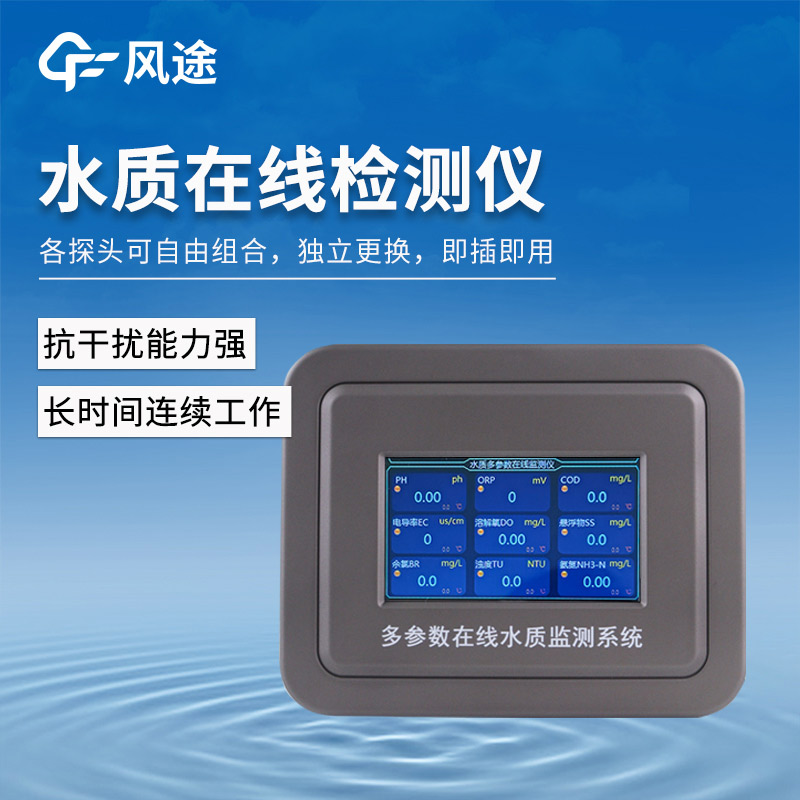
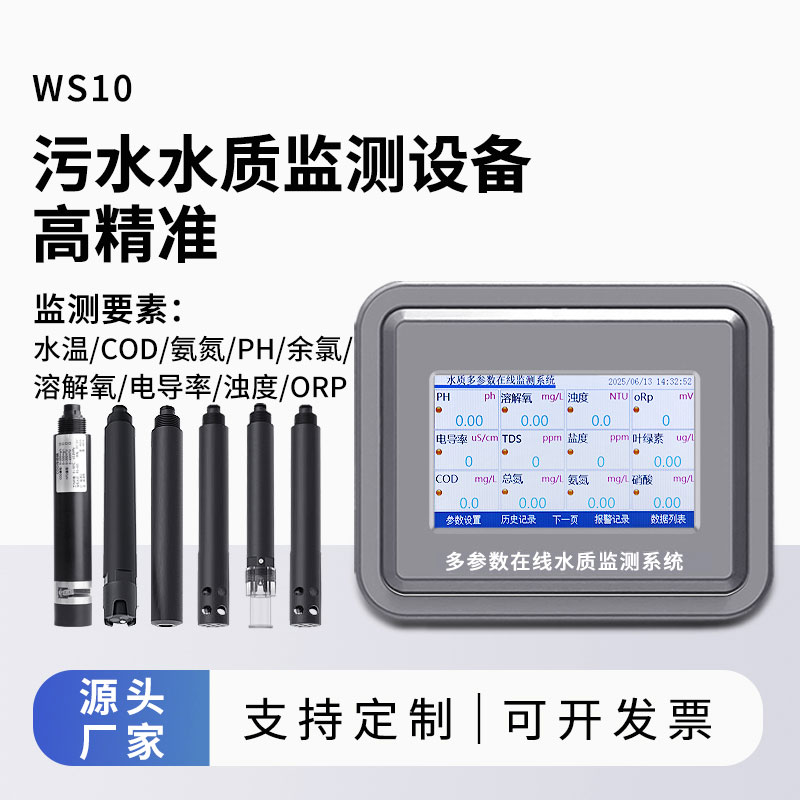
To accurately grasp the concentration of suspended solids in sewage, an Online Sludge Concentration Meter has become an essential facility for sewage treatment. Take FT-ZS10 as an example. It integrates high-precision water quality suspended solids sensors, measurement modules, communication modules, and data storage functions. Through the sensors, it can quickly and accurately measure the concentration of suspended solids in water and transmit real-time data to the control system or data center.
FT-ZS10 also supports the expansion of multi-parameter water quality sensors. In addition to suspended solids, it can monitor parameters such as ammonia nitrogen, ORP, pH value, dissolved oxygen (DO), conductivity, turbidity, and temperature. Users can flexibly select and combine sensors according to different needs and application scenarios.
The instrument can record and store historical monitoring data and alarm records, and supports the export of historical data in .xlsx format, facilitating long-term data preservation and analysis. In sewage treatment plants, FT-ZS10 can be used to monitor the concentration of suspended solids at the inlet and outlet to evaluate the treatment effect.
Among the many wind measuring instruments, wind cup anemometers have become more common in the history of their use because of their low cost and ease of use. But at the same time there are many problems, such as these mechanical devices due to moving parts, easy to wear and tear, the size of the ne...
A portable visibility sensor is a device capable of measuring the brightness of the surrounding environment and the visibility of the atmosphere. It usually uses laser or infrared technology to provide visibility data quickly and accurately by measuring parameters such as light scattering and reflec...
how to use the anemometer After holding the anemometer in the air and selecting the measurement options, you can calculate the wind speed....
Radar is a ground-breaking electronic technology of the 20th century, originating from an early system developed in the United Kingdom in 1935 to defend against airborne threats. Today, the technology has evolved and serves a number of important fields such as aviation, geographic mapping, weather m...


 Skype
Skype
 whatsapp
 mail
mail