Shandong Fengtu IOT Technology Co., Ltd
Sales Manager:Ms. Emily Wang
Cel,Whatsapp,Wechat:+86 15898932201
Email:info@fengtutec.com
Add:No. 155 Optoelectronic Industry Accelerator, Gaoxin District, Weifang, Shandong, China


Sales Manager:Ms. Emily Wang
Cel,Whatsapp,Wechat:+86 15898932201
Email:info@fengtutec.com
Add:No. 155 Optoelectronic Industry Accelerator, Gaoxin District, Weifang, Shandong, China
time:2024-12-31 10:04:50 source:Weather Station viewed:794 time
The measurement of wind is of great significance for weather forecasting. It can assist in analyzing weather systems, judging the convergence of air masses, providing a basis for early warnings of disastrous weather, and predicting air quality and the spread of pollutants. Through precise wind measurement, we can better understand weather changes, take preventive measures against disasters in advance, and ensure the safety of life and the environment.
There are mainly the following ways for people to measure wind speed:
Flight Anemometer: Its structure is that the upper part is responsible for rotation and the lower part is for recording. People assume that the wind speed can be obtained through a certain proportional conversion. However, this type of anemometer is not common because it has a circle of wire that generates friction, and in the case of low wind speed, the rotating part on the upper often fails to rotate, resulting in significant limitations in measurement.
Hot-Wire Anemometer (Wind Rheometer): A heated hot wire is placed in the flowing wind, and then the change in the temperature of the hot wire is observed to derive the wind speed. But this kind of anemometer is particularly susceptible to the influence of the external environment.
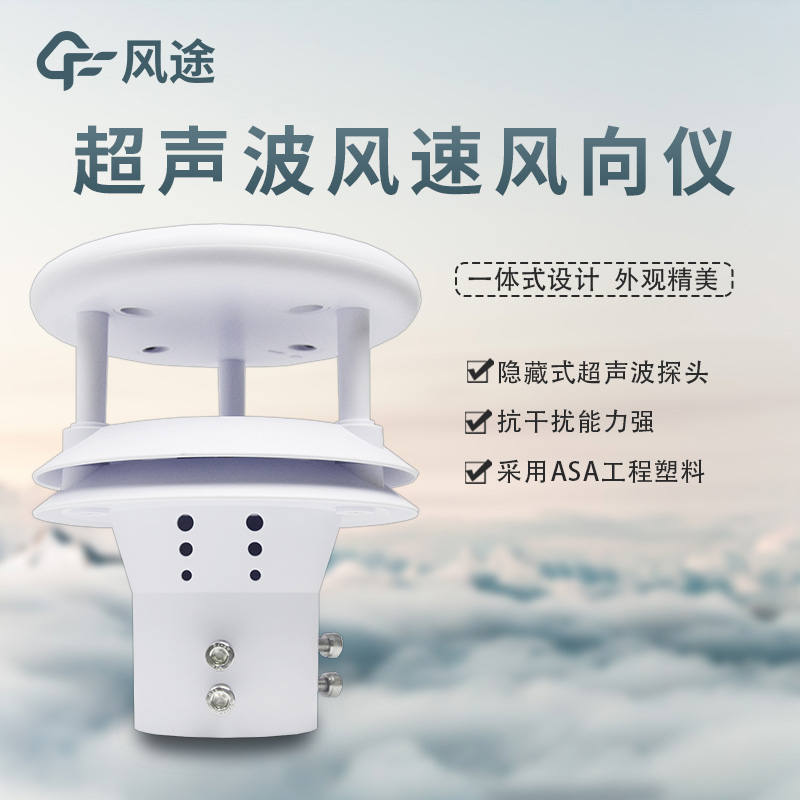
Mini Ultrasonic Anemometer: Its principle is that the propagation speed of sound in the air is constant under normal circumstances, but there will be two different values in downwind and upwind, and the wind speed can be indirectly calculated through this difference.
Other Methods: In addition to the above main methods, people have also invented the Doppler Laser Anemometer, the Air Pressure Difference Anemometer that requires long-term calibration, etc.
The Mini Ultrasonic Anemometer launched by Fengtu has the following advantages:
Integrated Structure in Appearance: It has an integrated appearance.
Imported Original Materials: It uses imported original materials, which are anti-oxidation, corrosion-resistant, and ultraviolet-resistant, ensuring that it will not change color after years of outdoor use.
Customizable Elements: The elements can be customized daily according to user needs, such as two elements, four elements, six elements, eight elements, etc.
High Precision: Each product has been calibrated in the laboratory before leaving the factory.
Dual Power Supply: It supports both AC and DC power supply, with standard protocols to ensure transmission. It can also be equipped with 232, wireless transmission, etc. according to user requirements.
Diverse Installation Methods: There are standard flange plate installation methods and other installation methods, and it can also be installed in a matching manner according to the on-site fixation method.
This is a full-color screen, highly intelligent negative oxygen ion monitoring station developed by Windway Technology on the basis of the old model, based on previous R&D experience! Interested, you can contact the customer for consultation! Next, let's see what features the device has!FT-F...
In wind farm operations, it is essential to collect wind speed and direction data. This is because wind speed directly determines the output power of wind turbines (power is proportional to the cube of wind speed). By using real-time wind speed data, combined with the turbine's power curve (the...
After the Beginning of Winter, adverse weather conditions gradually increase, posing great challenges to the safety and smoothness of road traffic operations. Thick fog reduces visibility drastically; continuous rain and snow make the road surface extremely slippery; the arrival of low temperatures...
Hello everyone, at present Windway Technology has been on the new tilt displacement monitor, also known as geohazard monitoring system, which is an online automatic remote geohazard monitoring and early warning system based on Internet of Things technology, recognizing the model FT-DH1, FT-DH2.In th...


 Skype
Skype
 whatsapp
 mail
mail