Shandong Fengtu IOT Technology Co., Ltd
Sales Manager:Ms. Emily Wang
Cel,Whatsapp,Wechat:+86 15898932201
Email:info@fengtutec.com
Add:No. 155 Optoelectronic Industry Accelerator, Gaoxin District, Weifang, Shandong, China


Sales Manager:Ms. Emily Wang
Cel,Whatsapp,Wechat:+86 15898932201
Email:info@fengtutec.com
Add:No. 155 Optoelectronic Industry Accelerator, Gaoxin District, Weifang, Shandong, China
time:2025-02-19 09:32:27 source:Weather Station viewed:829 time
After an earthquake, aftershocks often occur. An aftershock is a small earthquake that occurs successively after the main shock. It is generated because when the main shock occurs, the rock layers in the earth's crust are strongly impacted, and the internal stress distribution changes greatly. The originally relatively stable rock structure is damaged, and during the subsequent adjustment process, a series of small dislocations and fractures will occur, thereby triggering aftershocks.
The duration of aftershocks varies. Some last only a few days, while others can last for months or even longer. Although the magnitude of a single aftershock is usually smaller than that of the main shock, the superposition of multiple aftershocks can still cause further damage to already damaged buildings and infrastructure.
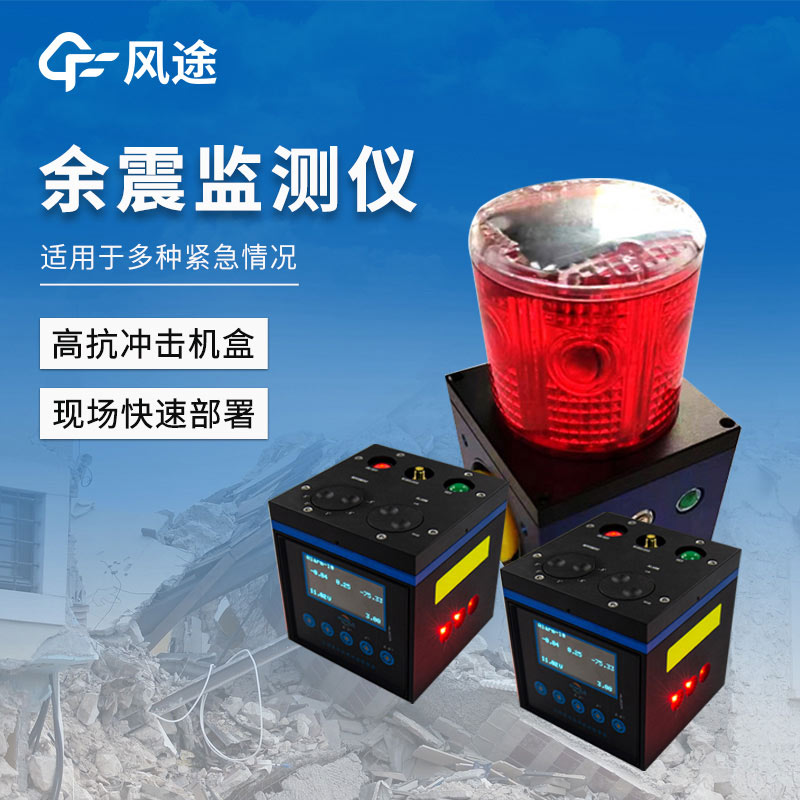
The Seismic Aftershock Monitoring System, an earthquake rescue equipment, is a powerful monitoring tool. Its core function lies in accurately capturing the minute displacement changes of objects. Whether it is the shaking of walls, the abnormal settlement and lateral displacement of building girders caused by fires, earthquakes, or collapse accidents, or the landslides, geological subsidence, and the expansion of ground cracks caused by natural disasters, the Seismic Aftershock Monitoring System can accurately capture these changes.
Once the movement of an object is detected, the Seismic Aftershock Monitoring System will immediately issue an alarm. This instant early - warning mechanism enables rescue workers to quickly become aware of potential risks, stop the current operations, and retreat to a safe area in a timely manner, thus minimizing the harm caused by secondary disasters. It ensures that rescue operations can be carried out in an orderly and efficient manner and protects the lives of rescue workers.
In addition, in the face of aftershocks, we should remain vigilant. After the main shock, evacuate to a safe and open area as soon as possible and avoid returning to buildings that may be dangerous. If there is no time to evacuate indoors, hide beside sturdy furniture and protect your head with soft items. Understanding knowledge about aftershocks and taking precautions can better protect our lives during earthquake disasters.
Hello everyone, at present Windway Technology has been on the new tilt displacement monitor, also known as geohazard monitoring system, which is an online automatic remote geohazard monitoring and early warning system based on Internet of Things technology, recognizing the model FT-DH1, FT-DH2.In th...
Radar level meters are widely used as liquid level measurement instruments, especially in many storage tanks, where they are used for level measurement. The radar level meter emits an invisible microwave pulse, which is then converted by internal components into a digital signal and displays an accu...
The measurement of wind is of great significance for weather forecasting. It can assist in analyzing weather systems, judging the convergence of air masses, providing a basis for early warnings of disastrous weather, and predicting air quality and the spread of pollutants. Through precise wind measu...
Environmental Sensors integrates six monitoring functions—temperature, humidity, illumination, PM2.5, PM10, and noise—delivering measurement accuracies of ±0.3°C for temperature, ±3% RH for humidity, and ±1.5 dB for noise. Data for all parameters is output simultaneously via an RS485 int...


 Skype
Skype
 whatsapp
 mail
mail