Shandong Fengtu IOT Technology Co., Ltd
Sales Manager:Ms. Emily Wang
Cel,Whatsapp,Wechat:+86 15898932201
Email:info@fengtutec.com
Add:No. 155 Optoelectronic Industry Accelerator, Gaoxin District, Weifang, Shandong, China


Sales Manager:Ms. Emily Wang
Cel,Whatsapp,Wechat:+86 15898932201
Email:info@fengtutec.com
Add:No. 155 Optoelectronic Industry Accelerator, Gaoxin District, Weifang, Shandong, China
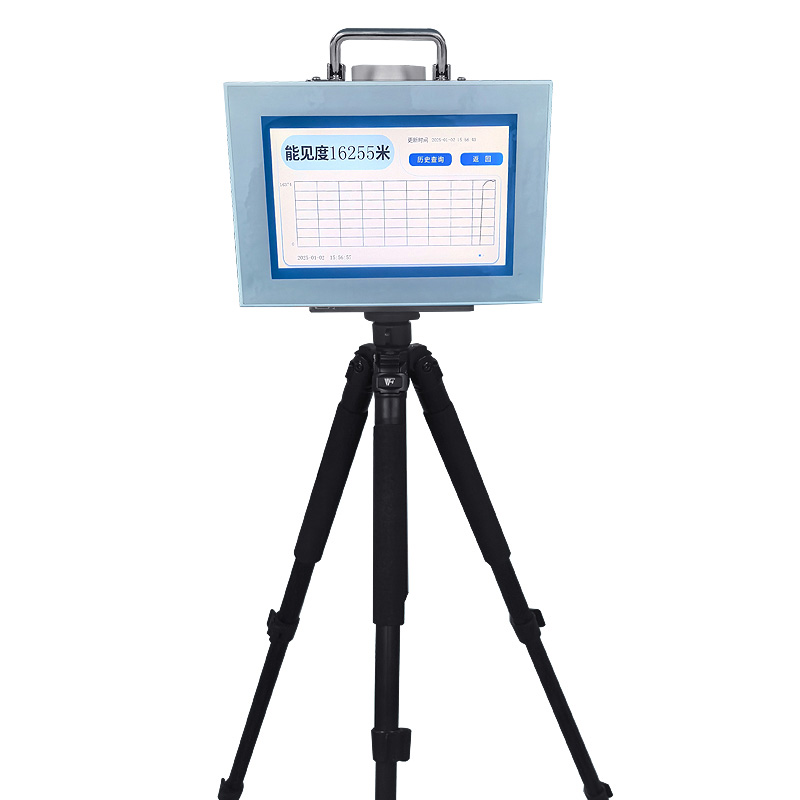
Model:FT-BN20
Brand:fengtu
1.Introduction to Portable Visibility detector
Portable visibility detector is a forward scatter visibility meter that is robust, lightweight and compact and can also be used for maneuvering measurements on moving carriers.BN20Portable visibility detector uses forward scattering method to measure the total extinction coefficient of the air and calculates the current visibility.It is widely used in emergency, road traffic, meteorological and other scenarios.
2.Technical features of Portable visibility detector
1.Integrated portable design, light weight, easy to carry, ready to use;
2.10.1-inch high-bright touch screen, displaying data and historical curves in real time; ☆
3.Built-in large-capacity SD card (8G), data is saved in real time, and it supports query and export;
4.Built-in large-capacity lithium battery, which is convenient for outdoor emergency use;
5.The instrument shell is high-quality aluminum material, and the whole machine has excellent waterproof, dustproof and collision-proof performance;
6.Built-in watchdog circuit to ensure reliable and stable outdoor operation for a long time;
7.The instrument communication and power interfaces both contain lightning protection designs, which greatly reduce lightning strikes and static damage;
8.24V power supply, low power consumption, and can be powered for a long time;
9.The digital interface uses RS232 and is uploaded actively without adaptation protocol;
3.Portable visibility detector execution standards
QX/T 536-2020 Forward scattering visibility meter test method
4.Portable visibility detector technical parameters
| Main parameters | Parameter range | Resolution | error | |
| Range | BN10 | 10km☆ | 1m | ≤2km ±2%2km~10km ±5%>10km ±10% |
| BN20 | 20km☆ | |||
| Repeatability | ≤4% | |||
| Operating temperature | -20~60℃ | |||
| Working humidity | 0~100%RH | |||
| Working power supply (adapter) | 100-240V input 24V output 2.5A | |||
| Power consumption | <10W | |||
| Battery capacity | 6.6AH | |||
| Working hours | ≥12h | |||
| size | 300x150x220mm (Length x Width x Height) | |||
| weight | ≤10kg | |||
Agricultural productivity is closely linked to meteorological conditions, making the monitoring of climatic conditions on farmland particularly critical. However, although full-featured agro-meteorological monitoring stations can provide comprehensive monitoring data, they are often inconvenient in...
"Waterloo" was originally the name of a city, but as time passed, it came to mean something else: a critical event that failed at a decisive point. This is because Napoleon was defeated at Waterloo and went from strength to strength.Victor Hugo wrote in Les Misérables: "If it had not...
Sensors used to detect the amount of rainfall include "resistance sensors", "piezoelectric sensors", and "photoelectric sensors".Principle of Piezoelectric Rain SensorPiezoelectric rain sensors utilize the impact measurement principle to measure the weight of individual...
Water level meter is a product launched by Windway Technology, model FT-SW1, which can measure water level data of waters in real time, including rivers, lakes, reservoirs, dams and other areas. It uses a radar water level sensor that measures water level information in a non-contact manner using K-...


 Get a Free Quote
 Skype
Skype
 whatsapp
 mail
mail