Shandong Fengtu IOT Technology Co., Ltd
Sales Manager:Ms. Emily Wang
Cel,Whatsapp,Wechat:+86 15898932201
Email:info@fengtutec.com
Add:No. 155 Optoelectronic Industry Accelerator, Gaoxin District, Weifang, Shandong, China


Sales Manager:Ms. Emily Wang
Cel,Whatsapp,Wechat:+86 15898932201
Email:info@fengtutec.com
Add:No. 155 Optoelectronic Industry Accelerator, Gaoxin District, Weifang, Shandong, China
time:2024-06-26 08:41:15 source:Weather Station viewed:992 time
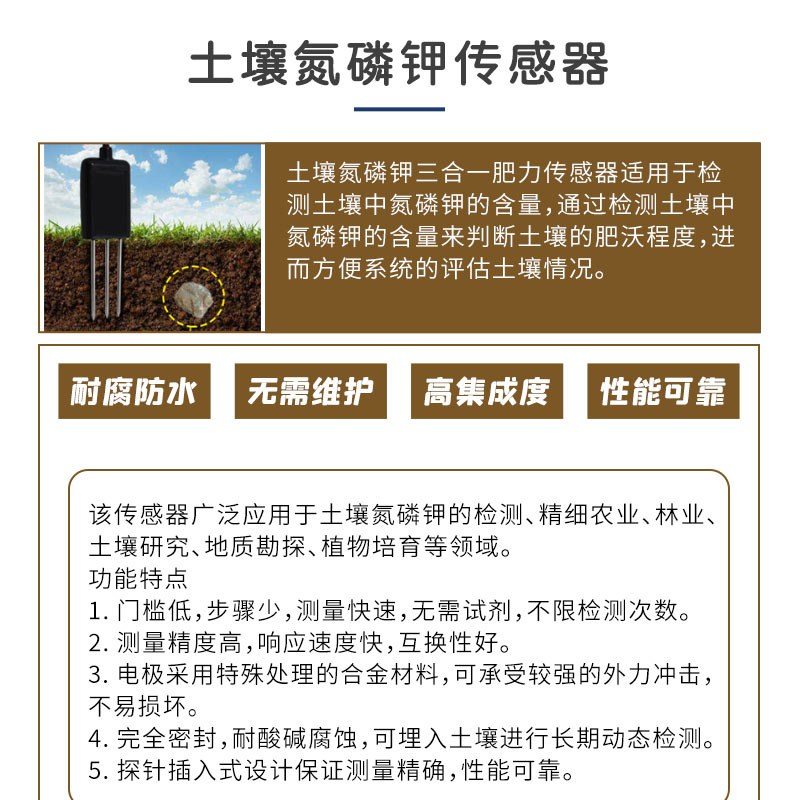
Smart agriculture projects require real-time monitoring of the soil, especially nitrogen, phosphorus and potassium levels, which helps to understand soil fertility, promote crop growth and increase agricultural yields.
Agriculture is transitioning to more scientific and precise growing methods, and the standards for cultivating crops are becoming more stringent. The use of sensors to accurately measure soil nutrients allows agricultural managers to accurately apply fertilisers accordingly, which both promotes healthy plant growth and pushes agriculture forward in the direction of intelligence.
Soil Nitrogen, Phosphorus and Potassium (NPK) sensors are specifically designed to detect chemical constituents in soil and fertilisers, and are able to quickly determine the amount of NPK in the soil. Using these sensors to assess soil nutrient levels can help us to understand the nutrient status of the soil, which in turn allows us to effectively use the natural nutrients in the soil and target deficient nutrients to optimise soil fertility.
Nitrogen, phosphorus and potassium are essential for plant growth. They are involved in the formation of essential organic substances in plants and activate enzymes for growth and metabolism. Every physiological process in plants requires the synergistic action of these elements, which work together to maintain proper plant development.
Designed for long-term soil monitoring, this sensor has excellent resistance to electrolysis and corrosion and is fully waterproof through vacuum encapsulation. It is used in a wide range of applications including soil nutrient determination, precision agriculture, forestry management, soil science research, geological exploration and plant breeding.
Wind speed monitoring is a critical task during UAV flight. It not only helps the flight control system to develop a flight plan and adjust it in real time, but also provides critical environmental data to ensure flight safety. However, UAV wind speed and direction monitoring faces several challenge...
greenhouse sensors Monitor the environmental conditions of the greenhouse and integrate the light sensor, carbon dioxide sensor, air temperature sensor, air temperature and humidity sensor....
In the process of agricultural development will be affected by a variety of factors, such as rainfall, etc., rainfall in a year is uniform, to ensure the growth of crops, on the contrary, uneven rainfall, there will be drought, flooding and other disasters, bringing great harm to the growth of crops...
Piezoelectric Six Elements Sensor FT-Y6 is a high-performance meteorological monitoring device capable of simultaneously measuring six meteorological elements such as temperature, humidity, wind speed, wind direction, atmospheric pressure and rainfall. It adopts advanced piezoelectric sensor technol...


 Skype
Skype
 whatsapp
 mail
mail