Shandong Fengtu IOT Technology Co., Ltd
Sales Manager:Ms. Emily Wang
Cel,Whatsapp,Wechat:+86 15898932201
Email:info@fengtutec.com
Add:No. 155 Optoelectronic Industry Accelerator, Gaoxin District, Weifang, Shandong, China


Sales Manager:Ms. Emily Wang
Cel,Whatsapp,Wechat:+86 15898932201
Email:info@fengtutec.com
Add:No. 155 Optoelectronic Industry Accelerator, Gaoxin District, Weifang, Shandong, China
time:2024-06-20 08:42:59 source:Weather Station viewed:1237 time
Soil is an extremely valuable resource on Earth that supports all terrestrial ecosystems. To make good use of and protect the soil, it is necessary to constantly check its various conditions. This requires the use of advanced measuring tools that can tell us the moisture, temperature and other important information about the soil. With these tools, we can manage the soil better and make it healthier and more productive.
Soil sensors are very important to modern agriculture, they help monitor the moisture, temperature and conductivity of the soil. Conductivity tells us how much salt is in the soil, which is critical for fertiliser application. Each plant needs different amounts of salt at different stages of growth, so measuring conductivity helps us apply fertiliser more scientifically.
Soil moisture shows how wet the soil is, expressed as a percentage. Knowing how soil moisture and temperature vary can help us decide when to irrigate and make sure our crops have the right amount of water. It allows farmers to take better care of their crops and grow better plants.
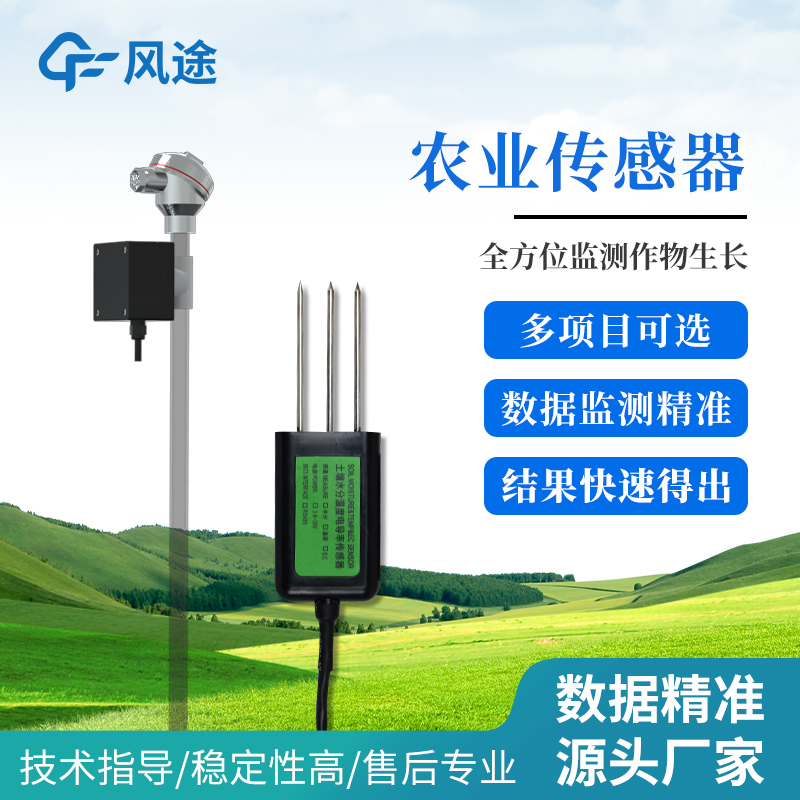
The Soil Triple Sensor (Soil Temperature, Moisture, and Salt Sensor) is a high-tech tool that measures the moisture, salinity, and temperature of the soil at the same time. Moisture is measured by the frequency of electromagnetic waves, salt is detected by electrodes, and temperature is sensed by a specially designed chip. This sensor allows farmers to get a quick overview of soil conditions, helping them to better manage their farmland.
It is a reliable and responsive device that plays an important role in the study of the formation, change, and improvement of saline soils, as well as the movement of water and salt.
How should this sensor be used?
To measure the soil on hard ground, drill a small hole, insert the probe and press the soil. When using the measurer, hold it gently and avoid dropping it. Because the measurer is black, it tends to absorb heat, so be careful to protect it from the sun when you use it outdoors, and don't let it get too hot, which will affect the measurement results. Simply put, handle it carefully and protect the measurer.
Weather forecasts provide timely information on the weather in the coming days. In the case of typhoon and rainstorm forecasts, precautions need to be taken in advance, and as modern agriculture continues to develop, the agro-meteorological environment is increasingly being taken into account. Espec...
An anemometer is a tool used to measure wind speed and direction. There are several ways to measure wind, but there are three main types. It is crucial to pick the right anemometer for your needs.A three-cup anemometer is an instrument that consists of two parts: a wind vane and an anemometer. This...
Literally, it refers to the physical state of the road surface. For example, whether there is water accumulation, snow, ice, or moisture on the road? What are the road surface temperature and humidity? These factors constitute the road surface conditions, which are often crucial to travel safety. Fo...
The GNSS displacement monitoring station is a device that utilizes Global Navigation Satellite System (GNSS) technology and is specifically designed for surface displacement monitoring. It receives satellite signals and accurately monitors the slightest changes in the target position. It is widely u...


 Skype
Skype
 whatsapp
 mail
mail